There’s a particular kind of exhaustion that doesn’t show up on the outside.
It’s the exhaustion of the woman who is doing everything right. Building the career, showing up for her family, growing her business, maintaining her presence, and still feeling, underneath all of it, like she’s slowly disappearing.
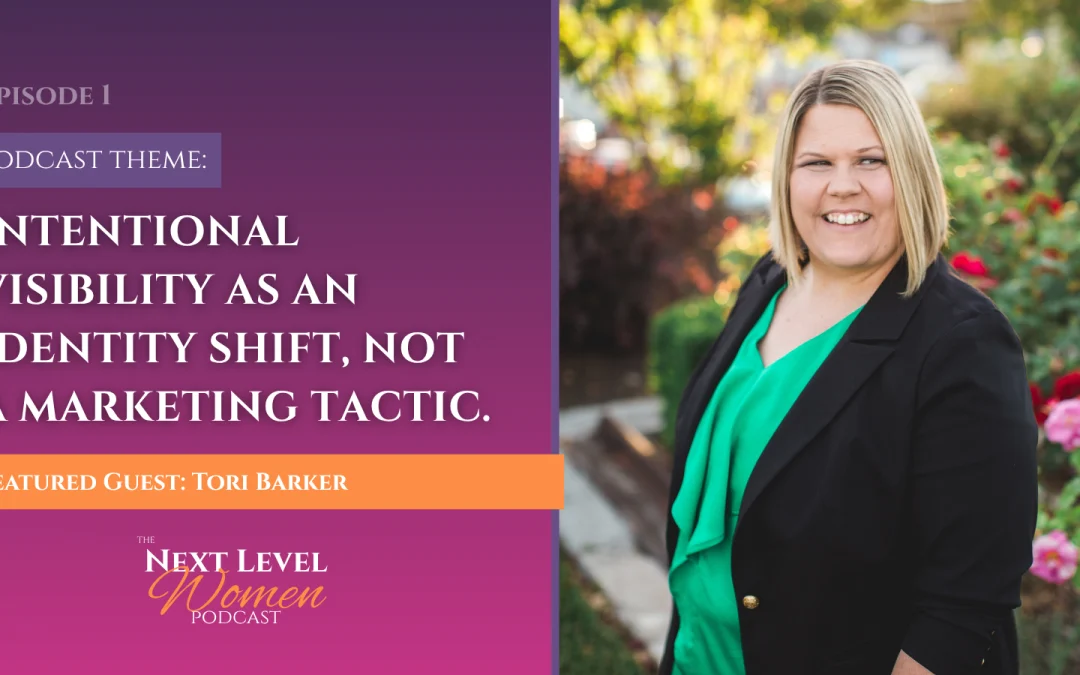
That’s what I kept coming back to throughout my conversation with Tori Barker on the very first episode of The Next Level Women Podcast. Not just what she said, but how familiar it felt. Because what Tori was describing wasn’t a niche experience. It’s something a lot of women are living right now, quietly, without quite having the words for it.
Why High-Achieving Women Start Performing Instead of Living Authentically
Tori has a background in corporate marketing, and she’s built her own consulting business since leaving that world. She’s thoughtful, direct, and genuinely unbothered by the kind of polished performance that tends to dominate conversations about visibility and personal branding.
At one point, she said something that stopped me mid-conversation:
“You really try to pigeonhole yourself into what you think you should be instead of being truly who you are.”
That’s not a new idea, but hearing it in the context we were discussing felt different. Women who are already working incredibly hard, already visible in many ways, already producing and showing up consistently are still feeling disconnected from themselves.
Because the problem isn’t that these women aren’t trying.
It’s that they’re trying to fit themselves into a version of success that was never really built around who they are.
The Pressure to Become Someone Else
The pressure is subtle. It’s not usually one loud moment telling women to “be different.”
It’s the slow accumulation of watching what seems to work for other people, absorbing what gets praised and rewarded, and gradually shaping yourself around that instead of around your own instincts.
Eventually, you end up performing a version of yourself rather than actually being yourself.
Tori’s point, and it’s one I think gets overlooked in most visibility conversations, is that the women who attract the right opportunities, relationships, and clients are rarely the ones who have perfected their personal brand.
They’re the ones who stopped trying to.
As she put it:
“When you can be yourself and confident in yourself and who you are, what you bring to the table, you’re gonna attract the people who are best suited for you.”
That sounds simple.
It’s not.
The Hidden Emotional Cost of Comparison and Curated Visibility
Why Authenticity Connects More Than Performance
One of the things I shared in this episode that I don’t always talk about publicly is that my own sense of visibility shifted when I stopped curating and started being honest.
Not manufactured honesty. The kind that’s packaged for relatability.
Actual honesty.
Showing the hard moments. Admitting the things that weren’t working. Letting people see something real.
What surprised me is that it worked better. Not because vulnerability is a strategy, but because people can feel the difference between someone performing and someone actually present.
We spent time in the episode talking about the highlight reel problem, which isn’t a new conversation, but it keeps mattering because it keeps doing damage.
Women are consuming curated snapshots of other people’s lives and measuring their own behind-the-scenes reality against it.
And that comparison has a way of quietly convincing you that who you naturally are isn’t quite enough.
That you need to become a louder, more impressive, more polished version of yourself to be worth paying attention to.
Nobody is living their highlight reel.
That includes the women whose feeds make it look like they are.
Why Doing More Never Makes Women Feel More Enough
There was a moment in our conversation where I asked Tori whether there was a specific point she realized that pushing harder wasn’t going to get her where she wanted to go.
Her answer was immediate:
“I didn’t have to do more to be more.”
I’ve been thinking about that line since we recorded.
Because so many high-achieving women have been operating under the belief that productivity equals worth.
That if they’re exhausted, at least they’re proving something.
That one more thing, one more launch, one more yes, one more effort will finally be the thing that makes them feel like enough.
But Tori’s experience, and honestly my own, is that the exhaustion that really grinds you down isn’t from working hard.
It’s from working hard while feeling disconnected from yourself.
That’s a different kind of tired.
And it doesn’t get fixed by rest alone.
It gets fixed by realignment.
Learning How to Slow Down Without Losing Yourself
After leaving corporate, Tori had to actively relearn how to work in a way that felt sustainable and honest.
She described it as learning:
“How to slow down and be mindful of the work that I do and intentional in the work that I do.”
Coming from an environment where output was the primary measure of value, that wasn’t a small shift.
It was a complete reorientation.

Building Success Without Sacrificing Your Life to It
One of the things I respect most about Tori is that she doesn’t just talk about work-life balance as a concept. She has actually structured her business around her real priorities.
She started her business specifically to have more availability for her family, and she’s made decisions, including hard ones, to protect that.
Work-Life Balance, Boundaries, and Intentional Leadership
That’s not easy to maintain when you’re also trying to grow something.
The pressure to always be available, always be producing, always be visible is real.
And women are often quietly penalized for the boundaries that protect their most important relationships and responsibilities, even in spaces that claim to celebrate them.
But what Tori models is that you don’t have to choose between building something meaningful and having a life that matters to you.
You do have to be intentional about it, though.
It doesn’t happen by default.
Why Pausing Creates Clarity, Alignment, and Self-Trust
Toward the end of our conversation, I asked Tori what she would say to a woman who is feeling invisible and worn out and isn’t sure what to do next.
I expected something practical.
A strategy.
A framework.
Instead, she said:
“The first thing that they need to do is they need to pause.”
And then she explained something that I think is genuinely important:
“When we get quiet and we pause, we can listen to our internal intuition.”
Most women who are in that state of exhausted invisibility are not pausing.
They’re reacting, managing, producing, adjusting, and pushing, all in the hopes that the next thing will finally make everything click.
But clarity doesn’t usually come from more movement.
It tends to come from stillness.
Stillness Is Not Laziness
Tori said it plainly:
“If you’re not quiet or still, you just keep moving and doing the things that you think you need to be doing.”
And that’s the trap.
Because the things you think you need to be doing are often just the things you’ve always done, the things you’ve watched other people do, or the things that feel productive even when they’re pulling you further away from yourself.
The pause isn’t laziness.
It’s how you actually hear yourself again.
What Becoming Your Next Level Actually Means
This conversation stayed with me, not because it offered a ten-step system or a new approach to visibility, but because it was honest.
Tori is someone who has done the internal work, and it shows. Not in her branding, but in how she talks about her life, her business, and what she’s actually after.
The women I most want to have on this podcast are the ones who are living what they’re saying.
Not performing authenticity, but actually practicing it, even when that’s harder and less impressive-looking than the alternative.
The Decision to Stop Abandoning Yourself
What I hope you take from this episode isn’t a new strategy.
It’s permission.
Permission to stop performing your way toward something that was never going to feel right anyway.
Permission to slow down enough to hear what you actually want.
Permission to trust that who you already are is not something that needs to be fixed or upgraded before you’re allowed to move forward.
The woman you’re becoming is built in the decisions you make next.
That includes the decision to finally stop abandoning yourself in order to be seen.
Connect With Tori Barker
Website: https://creativemarketingconsulting.com
LinkedIn: linkedin.com/in/toribarker
Visibility Quiz: https://creativemarketingconsulting.com/visibility-quiz
Want to Be a Guest on The Next Level Women Podcast?

If you have a story or perspective that could help another woman feel seen, empowered, or ready to step into her next chapter, we’d love to hear from you.